
When we polled our readers in last month’s newsletter asking what topic you wanted a deep dive into next, one strategy surged straight to the top of the list: 1031 exchanges in the Utah real estate market.
It makes perfect sense. Following up on our recent breakdown of how the ROAD to Housing Act created a massive moat for local Utah investors, independent operators across the state are stepping into a strategic window. Wall Street funds are sidelined from acquiring existing single-family stock, and with median single-family home prices hovering at $645,000 in Salt Lake County and exceeding $740,000 in Salt Lake City proper, local landlords are sitting on unprecedented levels of home equity.
However, in today’s maturing market—where statewide inventory has expanded to over 19,000 active listings and average days on market sit around 50–70 days—selling an asset outright can hit you with a massive tax bill. Realizing gains through a traditional cash sale drains the very capital you need to acquire yield-producing assets in high-growth corridors like Silicon Slopes, South Jordan, or Ogden.
If you are looking to compound your portfolio across the Beehive State, deferring capital gains tax isn’t just an accounting tool—it is the single most powerful strategy for scaling local Utah real estate.
Here is how Utah investors execute a seamless tax-deferred exchange tailored directly to local market dynamics.
The Real Math: Why the 1031 Exchange Matters in Utah
At its core, Section 1031 of the Internal Revenue Code allows an investor to sell an investment property and roll 100% of the net proceeds into a new “like-kind” asset while deferring federal capital gains, state income tax, and depreciation recapture.
Without a 1031 exchange, selling an appreciated rental in Utah triggers four distinct tax obligations:
- Federal Capital Gains Tax: 15% to 20%
- Net Investment Income Tax (NIIT): 3.8%
- Utah State Income Tax: Flat 4.45%
- Depreciation Recapture: 25%
Comparing Execution Scenarios along the Wasatch Front
Consider a residential rental in West Valley City or South Jordan purchased years ago for $250,000 that now sells at the Salt Lake County median price benchmark of $750,000, yielding a $500,000 taxable gain:
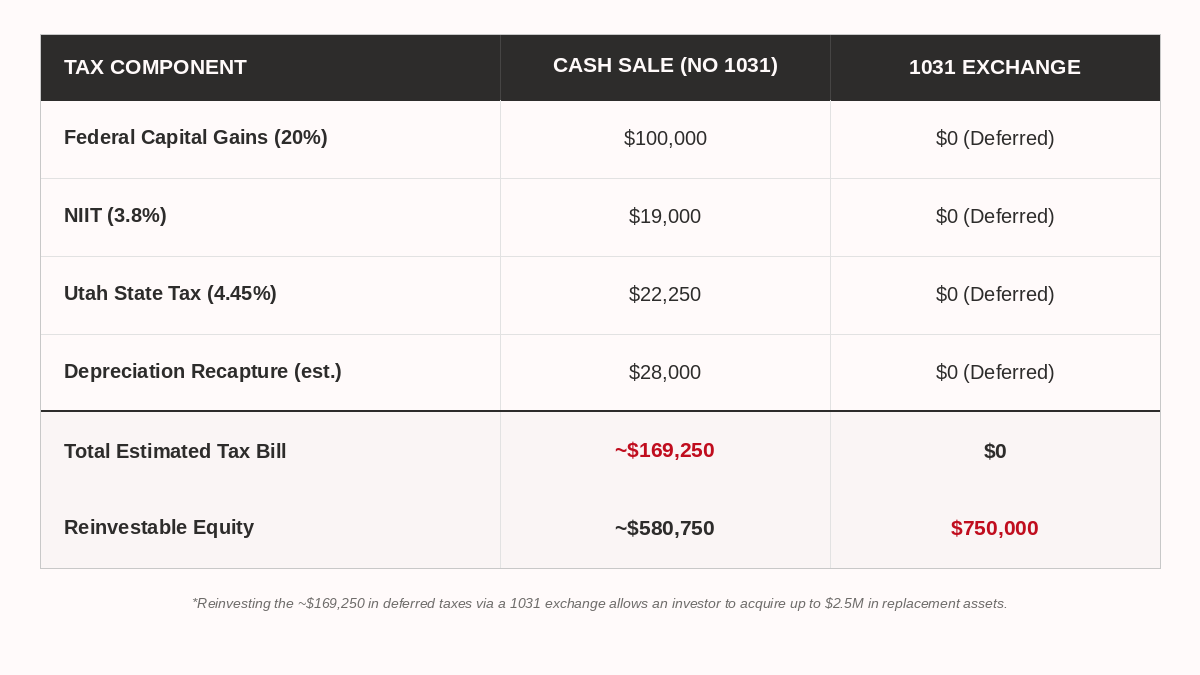
By preserving that $169,250 in equity via a 1031 exchange and leveraging it at 70% LTV, you can acquire up to $2.5 Million in replacement property, rather than stopping at ~$1.9 Million after paying taxes out of pocket.
Curious How Much Equity You’re Sitting On?
Whether you’re planning your next move or just evaluating your options along the Wasatch Front, knowing your home’s exact market value is step one. Schedule a quick conversation with our in-house 1031 real estate experts to run a free valuation, evaluate your current equity, and map out what leveraging your gains into a higher-yielding asset could look like.
Essential 1031 Exchange Timelines
The IRS applies two strict timelines to standard delayed exchanges. Missing either by even a fraction of a second forfeits the tax deferral completely.
Closing Date (Day 0)
Day 0
The sale of your relinquished Utah property closes. Sale proceeds transfer directly to your Qualified Intermediary (QI) to prevent constructive receipt.
45-Day Identification Window
Day 45
You must formally identify potential replacement properties in writing to your QI. You typically identify up to 3 properties of any value (the “3-Property Rule”).
180-Day Acquisition Window
Day 180
You must finalize and close on one or more of the properties identified during the 45-day window.
Utah-Specific Market Dynamics Every Investor Must Watch
Executing a 1031 exchange in Utah requires navigating local market nuances that can disrupt an exchange if left unaddressed:
1. Navigating Utah’s Micro-Market Valuations
Utah is not a monolith; market performance varies widely by county and city:
- High-Equity Salt Lake & Utah Counties: With median home prices reaching $631,000 in Lehi and over $1.5 Million in Alpine, investors selling mature single-family assets along the I-15 corridor often face cap rate compression (4%–5%).
- Yield Shifts to Secondary Markets: To optimize cash flow, local investors are executing 1031 exchanges out of low-yield Salt Lake starter homes into higher-yielding multi-family units in Ogden (median ~$396,000) or high-growth infill sub-markets like Saratoga Springs, Eagle Mountain, and Payson.
2. Water Rights Allocation (Land & Agricultural Transfers)
In Utah, water rights are separate real property rights from the land itself. If you are exchanging land, agricultural acreage, or parcels with appurtenant water rights (such as shares in an irrigation company or perfected water deeds in Central/Southern Utah):
- Like-Kind Qualification: Water rights are considered real property under Utah law and can be exchanged for standard real estate, provided they are perpetual in nature.
- Administrative Delays: Conveying water rights through the Utah Division of Water Rights (adjudication and title updates) often takes significantly longer than standard county deed transfers. Plan for this extra processing time early in your 1031 identification period to protect your 180-day closing window.
3. Short-Term Rental (STR) Municipal & Legislative Headwinds
Exchanging an appreciated Wasatch Front property into a small multi-family asset—such as a duplex or fourplex in West Jordan, Lehi, Ogden, or Provo—is a popular 1031 playbook. However, when investors look at converting residential units into short-term or vacation rentals, extreme caution is required:
-
Strict Licensing Quotas & Non-Transferability: Municipalities across Utah heavily restrict, cap, or outright ban short-term rentals in residential zones. Acquiring a residential property does not guarantee a transferable STR permit—in many cities, permits reset or expire upon title transfer.
-
Insider Market Insight (Our Stand on STRs): While Nestwell focuses exclusively on managing long-term residential rentals and does not manage vacation or short-term rentals, our advisory team strongly urges investors to exercise heightened scrutiny before allocating 1031 replacement funds into any Utah STR play. With newly enacted statewide and municipal legislation imposing rigorous operational requirements, strict licensing thresholds, and aggressive enforcement mechanisms, relying on short-term rental cash-flow projections carries substantial risk.
-
Investment Intent & Safe Harbor Compliance: Beyond local municipal rules, IRS Safe Harbor standards (Rev. Proc. 2008-16) mandate that a 1031 replacement property must be held primarily for investment. If personal use of an STR exceeds 14 days (or 10% of total rented days) in a 12-month period, you risk invalidating the tax deferral altogether.

Strategic 1031 Playbooks for Utah Portfolios
Wasatch Front Equity Consolidation (Scaling Up)
- The Play: Exchange two or three appreciated single-family units in West Jordan or West Valley City into a multi-tenant commercial asset or a multi-family complex in high-growth employment centers like Silicon Slopes or Provo. This consolidates management effort while boosting monthly yield.
Transitioning to Passive Income (The DST Alternative)
- The Play: Long-term Utah landlords looking to retire from active tenant management can exchange physical real estate into institutional-grade assets using a Delaware Statutory Trust (DST). A DST qualifies as “like-kind” property under IRS guidelines, allowing you to trade active landlording for passive fractional ownership in Class A industrial centers or multi-family communities across the West without triggering capital gains tax.
Frequently Asked Questions
What counts as “like-kind” real estate in Utah?
IRS rules defining “like-kind” real property are broad. Almost any real property held for investment or business use qualifies. You can exchange raw land in Utah County for an apartment building in Salt Lake City, a residential rental in Ogden for a commercial warehouse, or a single-family property for a Delaware Statutory Trust (DST). Primary residences do not qualify.
Can I convert a 1031 replacement property into my primary residence later?
Yes, but you must establish clear investment intent first. Under IRS Safe Harbor rules (Rev. Proc. 2008-16), you should hold the replacement property as a rental for at least 24 months after acquisition, renting it out at fair market rates for at least 14 days per year, before converting it to personal use.
Does Utah charge state-level capital gains taxes on 1031 exchanges?
Utah follows federal 1031 tax rules. As long as you comply with federal Section 1031 requirements, your state income tax liability (at Utah’s flat 4.45% rate) is deferred alongside federal taxes.
Ready to Leverage Your Equity into Your Next Big Deal?
Don’t let tax drag slow down your portfolio growth. If you want to know what your property is worth in today’s Utah market—or how to structure a seamless 1031 exchange into a high-performing long-term rental—our local real estate team is here to help.
Talk with a Nestwell 1031 Specialist Today or give us a call to explore how to keep 100% of your capital working for you.