

If you have been bidding on single-family properties along the Wasatch Front over the past five years, you know the frustration. You find a solid duplex in West Valley or a single-family home in South Jordan, run your numbers, submit a clean offer, and get outbid by an institutional mega-fund dropping all-cash offers at zero-cap rates.
That dynamic just changed overnight.
With the passage of the 21st Century ROAD to Housing Act, federal legislation has officially set strict limits on Wall Street’s footprint in residential real estate. But while headlines across the national news focus on what this means for institutional hedge funds, local investors on the ground in Utah are sitting on a completely different story—one that gives mid-sized and independent real estate investors the biggest competitive moat we’ve seen in a decade.
Having managed and analyzed Utah real estate trends at Nestwell since 1980, we’ve seen every market cycle, policy shift, and legislative update hit our local neighborhoods. Here is our breakdown of what the ROAD to Housing Act actually means for your portfolio—and how local operators are positioned to win.
What the ROAD to Housing Act Actually Does (and Doesn’t Do)
To understand your competitive advantage, you first need to look closely at the fine print of the new federal law:
-
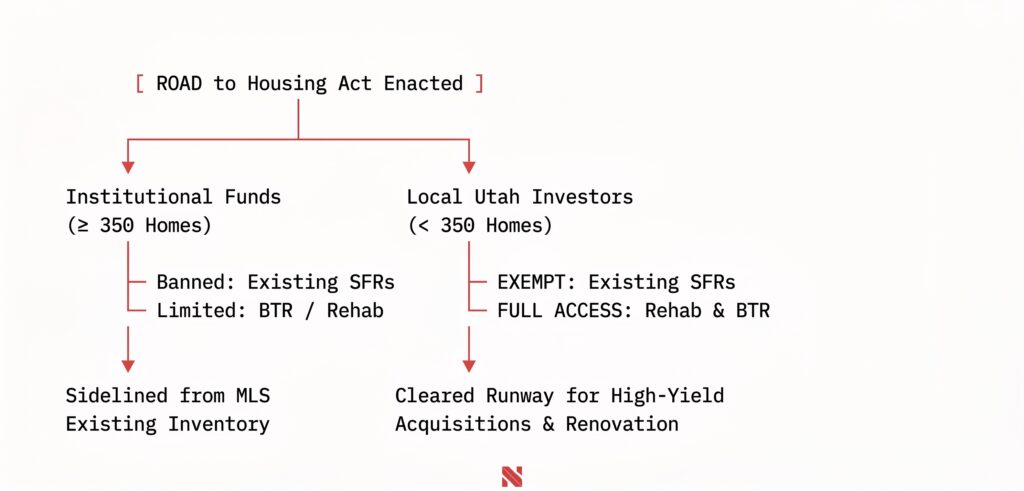
The Core Ban: Prospective institutional buyers controlling 350 or more single-family homes are banned from acquiring existing single-family residential (SFR) properties.
-
No Forced Sell-Offs: The act does not force mega-funds (like Progress Residential or Invitation Homes) to liquidate their current holdings. Their existing Utah inventory remains intact.
-
The Local Exemption: Local and regional Utah operators managing or owning fewer than 350 homes are fully exempt.
-
The Carve-Outs: New construction (Build-to-Rent) and major renovation/rehabilitation projects remain carved out to encourage net-new housing supply.
Here is how the playing field shifts when comparing national institutional funds with local Utah investors:
|
Feature / Policy Impact |
Wall Street Mega-Funds (350+ Homes) |
Local & Regional Utah Investors (<350 Homes) |
|
Existing SFR Purchases |
Banned nationwide |
Unrestricted |
|
Bidding Competition |
Sidelined on MLS & off-market existing stock |
Major drop in institutional bidding wars |
|
Build-To-Rent (BTR) |
Permitted (New Construction) |
Permitted |
|
Renovate-to-Rent / Fix & Flip |
Heavily restricted / High compliance barrier |
Full green light (Exempt) |
|
Local Market Agility |
Slow corporate adjustments to state laws |
Fast execution on local legislative shifts |

Scenario Analysis: How the ROAD Act Hits the Wasatch Front
Let’s process a real scenario playing out across Salt Lake, Utah, and Weber counties right now.
Scenario A: The Existing Single-Family Market (West Valley, Salt Lake City, Ogden)
Before the legislation, when a $420,000 starter home hit the market in Salt Lake County, local investors had to compete with institutional capital that cared more about deploying capital at scale than local cap rates.
-
The Result Today: Wall Street is frozen out of acquiring existing single-family inventory. This removes the artificial price ceiling created by institutional bidding wars. Local buyers now have room to negotiate seller concessions, inspect thoroughly, and secure acquisitions at realistic debt-yield ratios.
Scenario B: The Renovation Opportunity (Renovate-to-Rent)
Because institutional giants are restricted from buying existing stock to upgrade, aging housing stock along the Wasatch Front (particularly 1970s–1990s builds needing capital improvements) will rely entirely on local capital.
-
The Local Advantage: Local investors who understand neighborhood-specific rent comps can acquire distressed or dated properties, execute targeted renovations, and capture strong forced equity along with premium local rents.
Connecting the Dots: Federal Policy Meets Utah Landlord Laws
Federal tailwinds are only half the equation. To build a resilient portfolio in 2026, you must align federal policy advantages with local Utah regulations.
As we highlighted in our recent breakdown of the New Utah Landlord Laws, Utah remains one of the most property-rights-friendly states in the nation. While national markets struggle with complex rent control measures and costly municipal mandates, Utah’s state legislature continues to maintain streamlined eviction processes, clear lease enforcement standards, and strong protections for property owners.
When you pair federal protection from institutional crowding with Utah’s landlord-friendly statutory framework, local investors enjoy an unprecedented environment for predictable cash flow and long-term equity growth.
3 Strategic Moves for Utah Investors Today
-
Target the “Sweet Spot” Inventory: Focus on 3-bed, 2-bath single-family homes and small multi-family units (duplexes/fourplexes) built between 1970 and 2005. Institutional buyers can no longer touch these, giving you prime negotiation leverage.
-
Leverage Renovate-to-Rent Carve-Outs: Take advantage of properties requiring moderate capital expenditure. You face zero institutional competition in this tier, allowing you to force equity while raising neighborhood rental benchmarks.
-
Maintain Strict Local Underwriting: While competition from mega-funds has softened, interest rates and local operating costs require precise underwriting. Make sure your gross rent multipliers and maintenance reserves account for actual Utah vendor pricing and current vacancy rates.
Maximize Your Local Advantage
Navigating shifting federal policies while optimizing for Utah’s local rental dynamics requires real data on the ground. Whether you are looking to expand your portfolio along the Wasatch Front or want to ensure your current rentals are delivering peak cash flow:
[Request a Free Rental Analysis with Nestwell]
Get accurate, neighborhood-level rent rates, cash-flow projections, and management insights from team members who have analyzed Utah real estate since 1980.